Search for novel quantum materials: Transitional metals and rare earth elements
We use density functional theory-based simulations to determine the optical properties of transitional metals and rare earth elements in wide-band-gap semiconductors. Some of the examples are iron-doped GaAs, copper, cobalt, nickel-doped ZnS, and erbium-doped yttria. Rare earth elements in optical materials have been extensively studied due to sharp electronic transitions between electronic levels of partially filled f-shells resulting in a high quantum efficiency with an optimal wavelength in telecommunication applications, optical amplifiers, high power solid-state lasers, optical storage, and data processing applications. Furthermore, the anisotropic g-factors of these dopants provide another degree of freedom, which is calculated from an effective crystal field Hamiltonian. We address the need for a systematic search for the right materials for quantum applications through simulation and plan to extend this search to include machine learning.
Topological Insulators and Weyl Semimetals
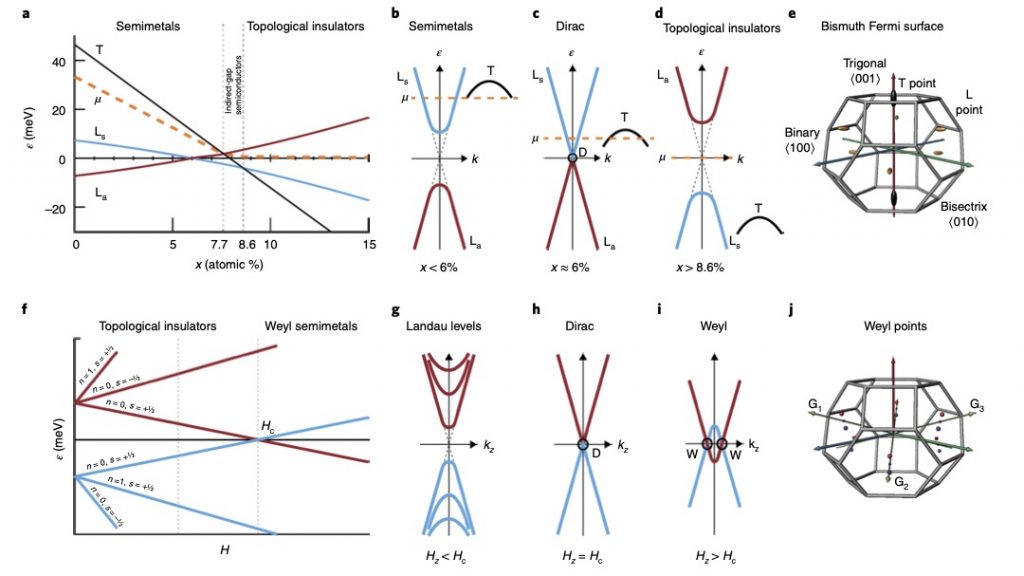
We are also interested in the chalcogenides such as bismuth and antimony alloys and show that they exhibit novel physical phenomena such as giant tunable spin-Hall conductivities and topologically protected phases. We prove that a moderate magnetic field can close the bandgap at the band edge due to very large g-factors. This prediction that the external field results in a topological change to the Weyl semimetal phase have been confirmed by an experimental group. The Weyl phase contributes to thermal transport, which causes a robust enhancement (300 %) of magneto-thermal conductivity. In another project, we address the question regarding the origin of the topological phases and show that this could be either bulk or surface states depending on the material. These predictions are confirmed by our experimental colleagues and the results are published in prestigious journals such as Joule and Nature Materials.